As the River Feale leaves the North Cork uplands, it meets the Kerry border - the two counties flanking its banks as it flows westward into a landscape shaped by words, tradition and memory.
In Brosna, local historian Larry Begley describes a place once known as the land of the "Rhymers" - poets whose role was both cultural and ceremonial:
"This area, going back to the 14th, 15th and 16th century, was called Rhymers… and the only thing they had to do every year… was entertain."
Further downstream, the Feale reaches the “Three Counties Bridge” where Cork, Kerry and Limerick meet. Built in 1958, it stands on a crossing that linked communities long before modern roads.
Beyond it lies Mountcollins, named after Father Luke Collins, a priest who built a church while evading the Redcoats in the 1700s:
As Larry explains "He built a small timber church with a thatched roof."
Beneath the surface, there are stories too - of underground tunnels, hidden escape routes, and even rumours of buried gold.
Flowing through Mountcollins village, the Caher River - one of the Feale's main tributaries - meets the Feale here, playing a vital role in the wider river system:
"It's an important one for salmon and sea trout spawning."
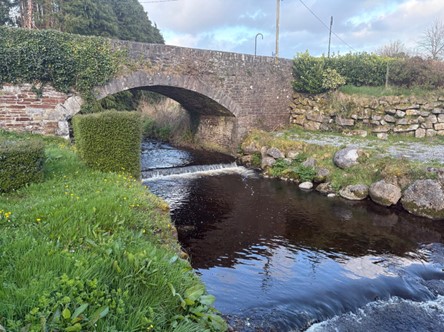
Caher River, Mountcollins
At "The Flats," Brendan Danagher of Brosna/Mountcollins Angling Club reflects on a river that shaped generations:
"It's a beautiful stretch of river… every 50 yards we have holding pools, which gives protection to salmon and sea trout."
But the Feale is changing. Brendan notes it now rises fast and hard:
"The river rises very fast… over eight or ten hours… and has tremendous speed."
Combined with declining water quality and sea lice from salmon farming, the pressure is mounting: "If that is to continue, you're going to see the decimation of Irish salmon rivers."
Fisheries Inspector Catherine Hayes says salmon tells the story of the river's health: "Their presence and abundance gives us a good sense of water quality and habitat health."
Despite the pressures, the Feale remains alive with kingfishers, otters, eels and dippers - "an absolutely magnificent ecological living thing."
Its future depends on the care it receives now.